The Core-to-Micro Method
Turn one piece of cornerstone content into weeks of posts: choose content pillars, create the core piece, then cut it into micro content per channel.
8 more sections in this guide, free with one email.Unlock now ↓

Creating high-quality content consistently is both essential and challenging. Many brands struggle to maintain presence across multiple platforms without sacrificing quality or exhausting their resources. The Core-to-Micro Method solves this problem by transforming your content production from a constant scramble into a systematic process that maximizes impact while respecting limited resources.
This method starts with substantial cornerstone content that directly addresses your audience’s primary needs, then strategically extracts multiple smaller assets adapted for different platforms. Rather than creating everything from scratch, you’ll learn to work smarter by repurposing effectively while maintaining your brand’s consistent voice and visual identity.
The payoff is significant: one comprehensive piece can generate 20+ platform-specific assets, ensuring message consistency while respecting each channel’s unique requirements. This approach not only saves time and resources but also creates a more cohesive brand experience for your audience as they encounter your content across various touchpoints.
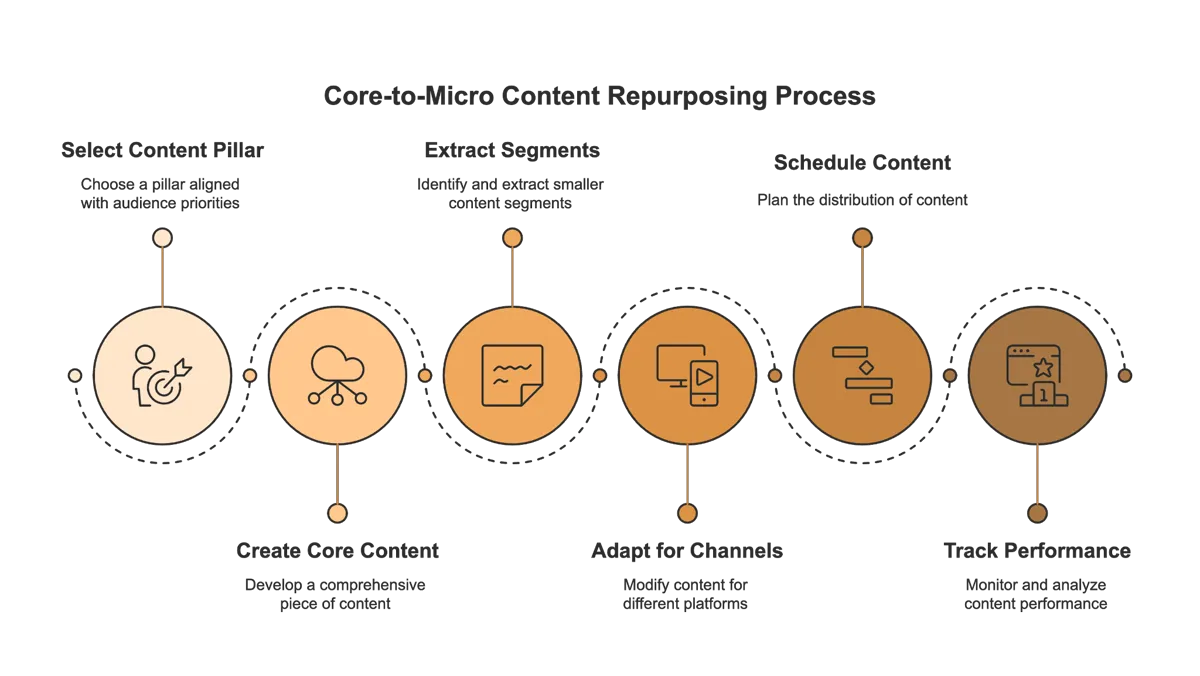
In this guide, you’ll learn exactly how to implement the Core-to-Micro Method in your own content strategy, with practical templates, real-world examples, and step-by-step instructions for turning one piece of content into many without losing quality or consistency.
Understanding the Core-to-Micro Framework
What Is the Core-to-Micro Method?
The Core-to-Micro Method is a strategic content repurposing system that starts with creating substantial cornerstone content (your “core”) that thoroughly addresses your audience’s primary needs. From this robust foundation, you then extract multiple smaller assets (your “micro” content) adapted to different platforms’ requirements.
This approach allows you to:
- Maintain consistent messaging across all channels
- Produce more content with fewer resources
- Ensure quality by starting with thoroughly researched cornerstone pieces
- Create platform-specific content that respects each channel’s unique format
- Build a cohesive content ecosystem that reinforces your brand at every touchpoint
Why Traditional Content Creation Falls Short
Most brands approach content creation in one of two problematic ways:
- The scatter approach: Creating unique content for each platform with little connection between pieces, leading to inconsistent messaging and exhausted resources
- The copy-paste approach: Using identical content across all platforms without adaptation, resulting in poor engagement as content feels out of place on each platform
The Core-to-Micro Method offers a middle path that balances consistency with platform optimization.
The Business Case for Systematic Repurposing
According to the book, a B2B software company that implemented this approach was able to generate 20+ content pieces from a single quarterly research report:
- 5 blog posts exploring specific findings
- 3 short LinkedIn videos featuring analysts
- 12 social media graphics highlighting key statistics
- An email series drilling into implications
- A webinar discussing practical applications
This systematic approach not only ensured message consistency but also respected each platform’s unique limitations and opportunities, resulting in dramatically higher engagement rates than their previous approach of creating separate content for each channel.
Selecting Your Content Pillars
The foundation of effective repurposing begins with selecting the right content pillars that connect your brand purpose to audience needs.
Defining Content Pillars
Content pillars are 3-5 consistent themes that directly link your brand purpose to your audience’s primary needs. Each pillar should:
- Align with your brand values and positioning
- Address a specific job-to-be-done for your audience
- Offer enough depth to support multiple content pieces
- Differentiate you from competitors
- Connect to your business objectives
Content Pillar Selection Exercise
- List your brand’s core values and positioning elements (from your brand foundation)
- Identify your audience’s top 3-5 jobs-to-be-done (from your audience research)
- Find the intersections between these lists
- Craft 3-5 content pillar statements using this format:
“We help [audience] to [accomplish specific goal] through [your unique approach].”
Content Pillar Worksheet
|
Brand Value |
Audience Need |
Content Pillar Statement |
Example Topics |
|---|---|---|---|
|
[Value 1] |
[Need 1] |
[Pillar Statement 1] |
[Topic 1, Topic 2, Topic 3] |
|
[Value 2] |
[Need 2] |
[Pillar Statement 2] |
[Topic 1, Topic 2, Topic 3] |
|
[Value 3] |
[Need 3] |
[Pillar Statement 3] |
[Topic 1, Topic 2, Topic 3] |
Example from the Book
A niche cycling apparel brand identified three content pillars that connected their values to audience needs:
- Performance Optimization: Helping amateur cyclists improve their performance through science-backed training approaches
- Gear Longevity: Teaching proper care and maintenance techniques to extend the life of cycling equipment
- Community Connection: Highlighting local cycling routes, events, and community members
Each pillar is directly connected to both their brand purpose (making cycling more accessible) and their audience’s core needs (improving performance, maximizing investment, and feeling connected).
Creating Your Cornerstone Content
Cornerstone content forms the foundation of your repurposing strategy. These comprehensive pieces provide the raw material for all your micro-content.
Characteristics of Effective Cornerstone Content
Your cornerstone content should be:
- Comprehensive: 1,500+ words for articles, 30+ minutes for videos/podcasts
- Evergreen: Relevant for at least 6-12 months
- Value-focused: Solving a specific problem for your audience
- Brand-aligned: Reflecting your voice, values, and positioning
- Structured: Organized with clear sections that can be extracted
- Multi-faceted: Addressing several aspects of a topic
Types of Cornerstone Content
Choose the format that best suits your brand voice, audience preferences, and team capabilities:
- Long-form articles/guides: Comprehensive written content with multiple sections
- Research reports: Original data or analysis on industry trends
- Case studies: In-depth examination of customer success stories
- Webinars/workshops: Recorded sessions addressing specific topics
- Long-form videos: Comprehensive tutorials or deep dives
- Podcast episodes: In-depth interviews or topic explorations
Cornerstone Content Planning Template
|
Content Element |
Details |
|---|---|
|
Content Pillar |
Which pillar does this address? |
|
Primary Audience |
Who is this specifically for? |
|
Job-to-be-Done |
What problem does this solve? |
|
Working Title |
What will you call this piece? |
|
Key Sections |
List 5-7 main sections |
|
Supporting Data |
What research/evidence will you include? |
|
Visual Elements |
What graphics/charts will enhance understanding? |
|
Call to Action |
What should readers do next? |
|
Production Timeline |
Research, writing, editing, design deadlines |
Cornerstone Content Structure Tips
Structure your cornerstone content with repurposing in mind:
- Use clear section headings that could stand alone as micro-content
- Include a mix of formats within the piece (data points, stories, examples)
- Create natural breakpoints every 300-500 words
- Include standalone quotes or statements that can be extracted for social media
- Incorporate visual elements that can be repurposed independently
- Write with a modular approach where sections make sense both in context and standalone
Extracting Standalone Segments
Once you’ve created cornerstone content, the next step is methodically breaking it down into standalone segments for shorter-form platforms.
The Extraction Process
- Map your cornerstone content: Identify all extractable elements including sections, key points, data points, quotes, and visuals.
- Create a content inventory: Document each extractable element in a spreadsheet with notes on potential platforms.
- Prioritize based on value: Rank elements based on audience relevance and impact potential.
- Identify natural groupings: Look for logical ways to combine smaller elements for medium-format content.
Content Element Extraction Worksheet
|
Element Type |
Original Section |
Key Message |
Potential Platforms |
Required Adaptations |
|---|---|---|---|---|
|
Section |
[Section title] |
[Core message] |
[List platforms] |
[Format changes needed] |
|
Data point |
[Specific stat] |
[Significance] |
[List platforms] |
[Visualization needed?] |
|
Quote |
[Exact quote] |
[Context] |
[List platforms] |
[Design template?] |
|
Example |
[Brief description] |
[Lesson] |
[List platforms] |
[Additional context needed?] |
|
Visual |
[Description] |
[What it shows] |
[List platforms] |
[Formatting needs] |
Example Extraction from a Research Report
From the B2B software company example in the book, here’s how they might extract elements from their quarterly industry research report:
Cornerstone content: 25-page industry research report titled “The State of Customer Experience in SaaS”
Extracted elements:
- Blog post 1: Expanded on the “Top 5 CX Trends” section
- Blog post 2: Detailed the “Implementation Challenges” section
- Blog post 3: Focused on the “ROI of CX Investments” data
- LinkedIn video 1: Featured their lead analyst explaining key findings
- LinkedIn video 2: Showed a customer implementing the recommendations
- Social graphic 1: Visualized the “54% increase in retention” statistic
- Social graphic 2: Created a quote card from the executive summary
- Email 1: Addressed the “Getting Started” section for new subscribers
This systematic extraction ensures no valuable content is wasted while maintaining consistent messaging across platforms.
Adapting Format and Language
The secret to effective repurposing isn’t simply reusing content, it’s thoughtfully adapting it for each platform while maintaining your brand voice.
Platform Adaptation Guidelines
For each platform, consider:
- Optimal length: What word count or duration performs best?
- Visual requirements: What dimensions, orientation, and style work best?
- Tone adjustments: How formal or casual should content be?
- Call-to-action norms: What actions do users typically take on this platform?
- Platform conventions: What content formats are native to this platform?